03 / Pup Out
Designing AI to support difficult emotions — without replacing human connection
An iOS consumer mental-health product exploring how AI can support emotional reflection and human connection — without replacing either.
My scope
I took Pup Out from research and product definition through interaction design and a working prototype.
I owned:
- user and domain research
- synthesis and product strategy
- defining the role and boundaries of AI
- end-to-end UI, UX and visual design
- prototyping and implementation with Claude Code and Codex
- marketing
The product is still in testing, so I treat it as a product hypothesis rather than a clinical intervention.
I started by exploring a broad question:
How might software better support people living through difficult emotional states?
My research looked at experiences around depression, bipolar disorder, seeking help, diagnosis, treatment, everyday life, and relapse.
What interested me was not only access to professional care. It was what happens in all the moments between care — when someone feels bad, isn't sure how serious it is, doesn't know how to explain it, or worries that other people won't understand.
The problem wasn't simply having someone to talk to
The research showed that emotional difficulty often comes with a second problem: it can be hard to interpret your own experience while you are inside it.
People may question whether what they feel is "real enough," rationalise it, suppress it, or struggle to tell whether a difficult moment is temporary or part of something larger. And when they do express it, other people often don't know how to respond.
That creates friction on both sides:
Research also challenged the idea of an AI therapist
One direction would have been to let people talk indefinitely to an AI. But the research made me cautious about that.
Professional support isn't valuable only because someone asks good questions. It also provides pacing, boundaries, interpretation, and a safe environment for working through difficult experiences.
An AI that continuously analyses someone's emotions could easily become overwhelming or over-medicalise an ordinary difficult moment.
That gave me a clearer role for the technology:
AI should facilitate reflection and communication — not replace the person on the other side.
I designed Pup Out as an emotional intermediary, rather than a chatbot.
The basic interaction became:
AI appears between expression and communication. It helps someone unpack what they have already written, but the person remains responsible for what they ultimately say.
Three principles shaped the product
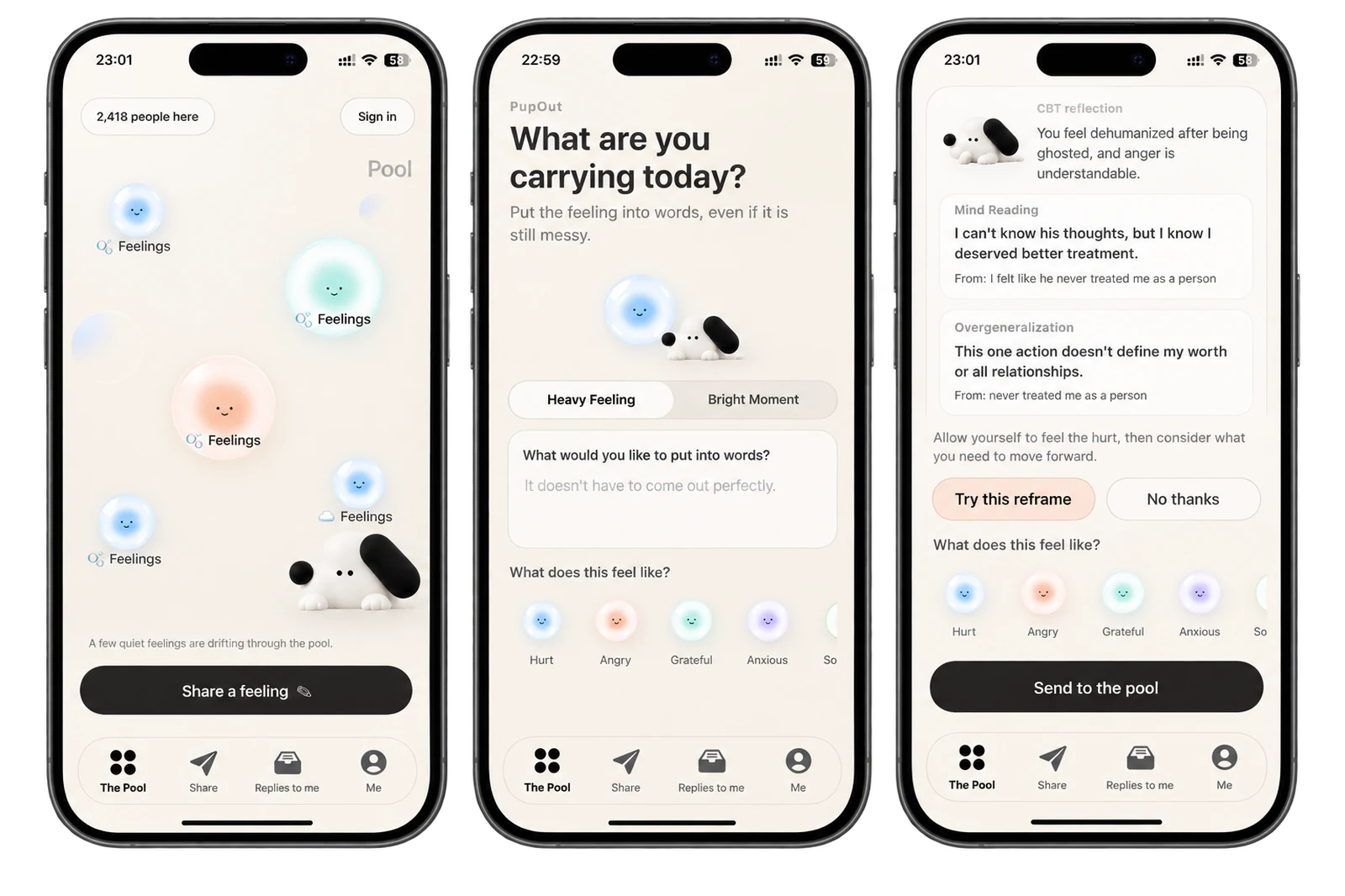
The Pool, the compose screen and the CBT reflection.
01 — Write first
"What are you carrying today?"
The user starts with their own words. There is no need to diagnose the feeling or choose from a clinical taxonomy first. The thought can still be messy.
The act of writing is the beginning of the reflection.
02 — Reflect before sending
The model looks for a pattern inside what has already been written. If it identifies a CBT-style cognitive distortion, it shows both the pattern and the specific language that led to that interpretation.
The user can then explore an alternative framing or ignore it.
The interaction pattern is deliberately simple:
03 — Let it go
When the user is ready, the feeling becomes a ball that can be dropped into the Pool.
I wanted expression to feel less clinical and more physical: write it → hold it → let it go
Another person can then encounter the thought and respond.
I wanted the interaction itself to embody the product idea. A thought becomes a small ball that can be dropped, bounced, and released into the Pool.
The metaphor gave difficult emotional expression a sense of lightness without turning it into a joke. It also made the name Pup Out something you actually do rather than simply branding.
The interaction animation. Screen recording from the Chinese build. Sound removed.
One of the most important product decisions was deciding when AI should appear. I focused it around two moments:
This made AI a contextual tool rather than the centre of the experience. It enters when it can help someone move forward, then steps back.
Designing for agency in a sensitive space
In mental-health-related products, even a suggestion can sound like a diagnosis if the interface presents it with too much authority. So I wanted AI interpretation to remain visible and contestable.
The product does not automatically rewrite someone's words or present its interpretation as fact. Instead:
- "Here's something I noticed."
- "Here's where I noticed it."
- "Here's another way to look at it."
- "You decide."
That became an important design principle throughout Pup Out.
I used Claude Code and Codex to turn the interaction into functioning software rather than stopping at static mockups.
That was particularly useful for the Pool, where much of the experience depends on movement, physics, timing, and responsiveness.
Instead of specifying the behaviour and handing it off, I could repeatedly:
AI didn't define the product. It allowed me to stay much closer to the final interaction while designing it.
Pup Out started as an exploration of how AI could support people experiencing mental-health challenges. The more interesting answer turned out to be about where AI should stop.
I don't think the strongest role for AI here is becoming another person to talk to. It is helping someone understand what they are feeling, helping another person respond with more care, and making the human conversation easier to have.
AI facilitates your emotions. It never replaces the conversation.
Because Pup Out is still in testing, the next step is validating the core behaviour:
- Does reflection help people express themselves more clearly?
- Do users trust AI more when they can see how an interpretation was made?
- Do people actually want a reframe before sharing?
- Does AI guidance make human responses more empathetic?
- Does the Pool create enough meaningful human connection for people to return?
The answers would determine which parts of the concept deserve to become a real product.